
Contributor Pack Templates for Events | Speaker Bio, Session & Article Guide
14/11/2025
Thin and Duplicate Content: What It Is and How It Harms Your Event
24/01/2026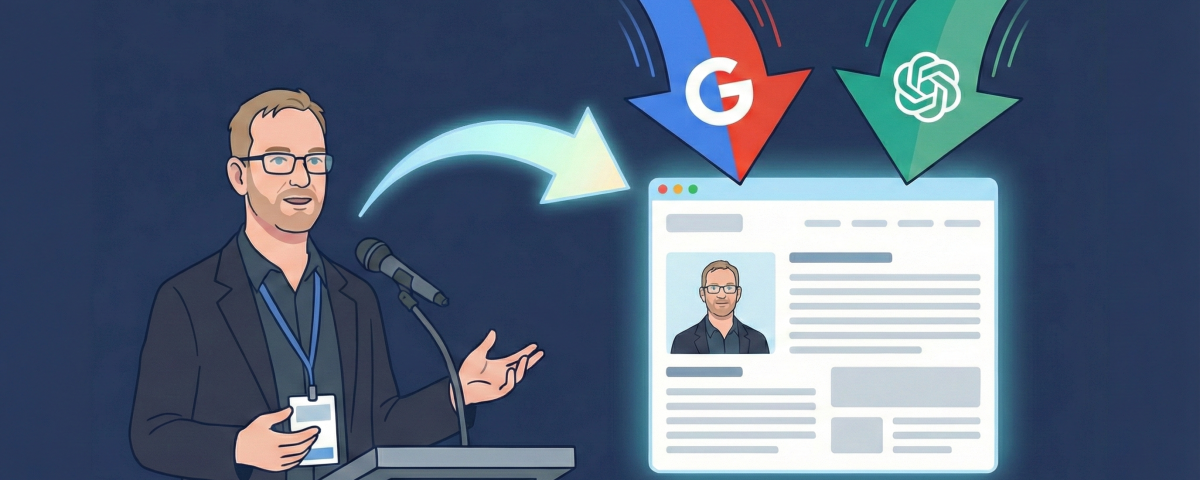
Your event sessions are packed with credible expertise, but most of that value never becomes searchable. This guide shows how to turn talks and panels into structured website content using AI, while staying accurate, speaker aligned, and internally linked so it can actually get discovered and drive registrations.
Why Event Content Marketing Changes When You Add AI
Event content marketing used to mean a highlights video, a few photos, and maybe a blog post if someone had time.
Now, your audience expects answers, not assets.
They search for problems, tactics, comparisons, and “what does good look like” long before they search for your event brand name. AI search tools do the same, but at scale. They reward clarity, structure, and authority signals.
The good news is you already have the raw material: talks, panels, workshops, and Q and A. The less good news is that raw material is messy. It needs shaping.
Many event websites get wiped clean after the event, and with it, all that search value. A session recording that disappears into a conference platform is not an asset. It is a memory.
The Big Mistake: Starting With The Transcript
If you want event content marketing that ranks and converts, you cannot start with the transcript.
You start with demand.
Because a transcript is not a topic strategy. It is just a lot of words.
Here is the uncomfortable truth: if you skip keyword research, you are essentially publishing into the void. You might still get a nice article. You just might not get any discovery.
Keyword Research Needs Real Volumes
You are targeting event content marketing (260 global searches a month). That is useful. It tells you there is demand.
But keyword research is not just picking a phrase you like.
It is validating things like:
- How people phrase the problem
- Whether they want a definition, a guide, examples, templates, or tools
- What “next step” intent sits behind the query
- Which related subtopics need their own pages so you do not cram everything into one mega post
This article will not teach the keyword research method itself. What matters is recognising that without real volumes, you are guessing.
Choose The Sessions That Are Worth Turning Into Pages
Not every talk deserves an article. Some sessions are timely, some are niche, and some are brilliant in the room but not useful out of context.
A session is a good candidate when it has at least one of these qualities:
- Evergreen problem: something people will search for in 6 months
- Repeatable learning: frameworks, checklists, steps, do and do not lists
- Clear audience: “for organisers” beats “for everyone”
- Speaker credibility: a speaker with genuine authority that you can signal properly
- Publishable language: not 40 minutes of inside jokes and acronyms
A panel can be even better than a talk, because the Q and A usually contains the real pain points. That is where search intent lives.
One Session Can Become Five Different Pages
A common mistake is turning a session into a single “recap”.
Recaps rarely rank. They are too vague.
A better approach is to convert one session into a small set of page types that match how people search. For event content marketing, these formats tend to do the heavy lifting:
-
Session Summary Page
What was covered, who it was for, and the key takeaways.
-
Topic Guide
A standalone guide that answers the broader question the session relates to.
-
FAQ Page
The questions people actually ask, with short direct answers.
-
Glossary Or Concepts Page
Definitions and clarity, especially useful for AI engines.
-
Comparison Or Options Page
“Approach A vs approach B” style content, where it makes sense.
The session becomes the source. The pages become the distribution.
That is how event content marketing stops being campaign content and starts being a library.
A Simple AI Workflow That Does Not Create Nonsense
AI is brilliant at speed. It is also brilliant at confidence. Those are not the same thing.
If you feed AI a transcript and say “write a blog post”, you will usually get one of these outcomes:
- A generic article that could have come from anywhere
- A plausible sounding piece that includes ideas never mentioned
- A summary that misses the real value because it cannot see what matters
- A rewrite that loses the speaker’s meaning
So the workflow needs guardrails.
Step 1: Clean The Source Material
Before you prompt anything, make the transcript usable.
That means:
- Remove sponsor reads, housekeeping, and repeated intros
- Fix obvious transcription errors (names, brands, acronyms)
- Keep speaker labels consistent
- Separate audience questions clearly
- Make sure the session title and speakers are written exactly the same way you write them on the site
This is boring work. It is also where accuracy starts.
Step 2: Decide The Page Type Before You Draft
Do not ask AI to decide what it is writing.
You decide.
Is this a topic guide, an FAQ, a set of takeaways, or a session summary page? Each one has a different structure and a different success metric.
If you do not specify the output type, AI will default to a bland blog post shape, regardless of what the transcript contains.
Step 3: Use Prompts That Match Your Editorial Rules
Prompts are not a small detail. They are the difference between “useful” and “nearly usable”.
Your prompts need to reflect:
- Your tone of voice
- The article type (guide vs summary vs FAQ)
- Your editorial rules (headings, paragraph length, clarity)
- Your copy standards (grammar, punctuation, capitalisation)
- Your accuracy constraints (transcript only, no extra facts)
- How you handle quotes (verbatim vs paraphrase)
This is where most teams underestimate the work. They assume AI writing is a single prompt. In practice, it is a sequence of prompts with checks in between.
A useful reminder from Google is that AI is not the problem. Low value output is:
“Appropriate use of AI or automation is not against our guidelines.”
Step 4: Force Transcript Grounding
If you want to reduce hallucination risk, you need to be explicit.
For example, your prompt rules might require:
- Only use claims that appear in the transcript
- If a detail is missing, say “Not stated in the session”
- Mark any uncertain statements for human review
- Keep examples within the session context, unless explicitly labelled as general guidance
This is not about being cautious for the sake of it. It is about protecting credibility.
Event content marketing only works if your content feels like it came from real expertise, not from a blender.
What To Do With Speaker Quotes Without Creating Risk
Quotes are one of the strongest assets you have. They also have the highest risk when AI gets involved.
You need a simple rule set.
Verbatim Quotes Stay Verbatim
If you use quotation marks, the words must match what was said.
You can remove filler words and tighten for readability, but you should not change meaning. If you do, it is no longer a quote.
Paraphrases Should Not Look Like Quotes
If you want to improve clarity, do it as a paraphrase.
For example:
- “In the session, the speaker argues that…”
- “Their main point was…”
- “A useful takeaway here is…”
This protects you from accidentally putting invented phrasing in someone’s mouth.
Decide Where Quotes Add Value
A strong pattern is:
- One quote early to establish credibility
- One quote mid way to add punch to a key idea
- One quote near the end to reinforce the closing takeaway
Do not overdo it. The page should not read like a transcript dump.
Speaker Authority Is Not Optional
Event content marketing lives or dies on trust.
If you publish session based content without properly linking it to the speaker, you lose one of your strongest authority signals.
Here is what “speaker aligned” content looks like on a site:
- The article clearly names the speaker and their role
- The speaker name is consistent across agenda, speaker profile, and article
- The article links to the speaker profile page
- The speaker profile page links back to the session content
- The session page links to the article as “Further insights” or similar
- If relevant, you link out to the speaker’s company or personal site
This is not just nice for users. It helps search engines and AI engines connect entities: person, company, topic, and event.
It also improves internal navigation. People do not just read articles. They follow speakers.
Structure For AI Engines: Clear Headings, Simple Topics
If you want AI engines to understand your page, you need to make it easy to parse.
That means:
- Headings that describe the section clearly
- Short sections that answer one thing
- Definitions where terms could be ambiguous
- Lists where steps matter
- Minimal fluff between useful sentences
This is where structure stops being a nice to have and becomes a citation signal.
“AI assistants reward content that reduces their uncertainty.”
A helpful rule: one heading, one job.
For example, if your H2 is “How AI Helps”, do not also cram in quotes, a warning about accuracy, and a mini rant about tools. Split it.
This also improves readability for humans, which is still the point.
Internal Linking: How To Make The Content Actually Discoverable
Publishing the article is not the finish line. It is the start of distribution inside your own site.
Internal links are the difference between:
- a page that exists
- a page that gets found
For event content marketing, the highest value internal links often come from:
-
Main menu or learning section
A “Insights” or “Content” item that does not disappear after the event.
-
Agenda and session pages
Link to the related article under the session description.
-
Speaker pages
Add “Articles and takeaways” blocks that point to relevant content.
-
Topic hub pages
Group content by themes like sponsorship, audience growth, content strategy.
-
High traffic evergreen pages
About pages, visitor info, exhibitor info, travel pages, depending on the site.
If your article is not linked from anywhere meaningful, search engines treat it like you treated it: as an afterthought.
Quick Wins You Can Apply This Week
If you want to move fast without making a mess, focus on these:
- Pick 3 sessions that map to evergreen problems, not event news
- Choose one page format per session, rather than trying to do everything
- Write headings first, then fill sections, it keeps the output structured
- Link every article to the speaker, and every speaker back to the session
- Add at least 3 internal links from agenda, speaker pages, and a navigation area
- Keep quotes either verbatim or clearly paraphrased, never a fuzzy middle
The Quality Layer Most Teams Underestimate
The hard part is not generating words.
The hard part is producing content that is:
- accurate
- on brand
- structured for discovery
- aligned to keyword intent
- linked into the site properly
- repeatable across dozens of sessions
This is why DIY repurposing often stalls after 2 or 3 attempts. It looks simple until you try to do it at scale and keep quality consistent.
AI makes event content marketing faster. It does not automatically make it better.
A Sensible Next Step
If you are serious about event content marketing, pick one theme that matters to your audience and build a small cluster:
- one solid guide
- one FAQ
- two session based takeaways pages
- all linked from agenda and speaker pages
Do that, and you will start building a content library that compounds, instead of a pile of post event leftovers.
Further Reading
Google Search’s guidance about AI generated content – A clear anchor on how Google thinks about AI, quality, and intent.
11 Genius Ways to Repurpose Your Event Content Like a Pro – Practical repurposing ideas you can map to session formats.
How to Repurpose Event Content Into Lead Generating Multi Channel Assets – Helpful for thinking beyond a single recap and building a content mix.
